It is more important to be able to judge when a hedge has reached the right stage for laying, than it is to know when it was last laid.
- Stems to be used as pleachers should be 8-12’ (2.4-3.6m) tall. When laid at an angle, these stems can be tucked tightly together to form a stockproof barrier. If the stems are any shorter than this, it becomes difficult to make the barrier sufficiently dense at the required height. Stems taller than about 12’ are usually larger than the recommended diameter (see below).
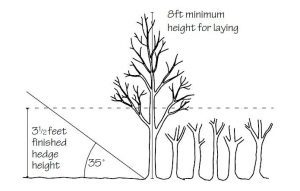
- Stems should be 2-4” (50-100mm) diameter at the base. These can be easily cut with hand tools, are not too heavy to lay into position, and are likely to be young enough to regrow vigorously. Very thin pleachers add little to the strength of the hedge, but may be laid in to increase its density. Very thick pleachers are difficult to lay without breaking, and hard to position in the hedge without displacing other pleachers or knocking stakes out of line. Stems larger than about 8” (200mm) are best cut off completely, or left to grow up as hedgerow trees.
- There should be sufficient stems available for you to be able to select the best ones for laying. Poor or awkward stems should be coppiced to regrow from the base.

Frequency of laying
The frequency of laying will depend on the hedge species and the rate of growth, which is affected by soil, altitude, location and other factors, as well as by previous management. Where hedges need to be stockproof, this is the main criteria in deciding when a hedge needs laying.
In good conditions, as on a fairly heavy but reasonably drained soil in sheltered situations, thorn hedges may have to be laid every seven to ten years, if the hedge is left untrimmed. In average conditions the interval between laying for untrimmed hedges is fifteen to twenty years, but in the uplands or where conditions are harsh, the hedge will grow more slowly and may only need laying every thirty years or so.
Hedges managed by annual trimming may thrive for half a century or more before the bottom starts to thin out, indicating that it should be left to grow up for laying.