
General points
Uses
Dune grasses may be used to:
- Trap sand at the eroding windward faces of dunes and so help maintain their positions
- Reduce the scouring effect of wind in blowouts and at the same time trap sand to help fill them in
- Consolidate areas of loose sand including blowout deposition areas, embryo dunes, newly contoured dune faces and zones of accretionalong fencelines. Fencing without planting does nothing to stabilise the sand surface.
Other considerations
- Transplanting is at present the cheapest and most effective way to establish species of dune-building grasses.
- Mixed dune grassland species may be transplanted by turfing but this must usually be augmented by sowing.
- Transplanting is usually most effective when done in conjunction with fencing or thatching. Transplanting is often benefited by mulching or binding, and in some situations fertilising may help. Thatching should normally be done before or at the same time as planting, rather than afterwards which may damage the plants.
- Protective fencing is often required around planted areas to prevent public access while the plants become established. It may be possible to limit fencing to the tops or crests of dunes and ridges. People tend to avoid climbing dunes which are vegetated and closed off at the top, provided convenient paths are made available in less vulnerable areas.
Species
The most useful species to plant on bare sand and to initiate new dune development are the three natural dune-forming perennial grasses: sand couchgrass, sea lyme grass and marram. Marram is most widely used but the others may be preferable in certain circumstances. All have the ability to slow the wind and trap sand without causing scour. They maintain their effectiveness (within limits) by growing out and up through new deposits.
Sand couchgrass
Sand couchgrass or sand twitch (Elymus farctus syn. Agropyron junceiforme) is almost universal around the coasts of the British Isles wherever there is moderate sand blow. It is the usual pioneer of embryo dunes since even as a seedling it stands salt and can grow within reach of the high spring tides. Its extensive rhizomes creep through the sand and send up new aerial shoots when buried, as long as the annual sand accretion is under about 300mm (1′). If sand blows out from around the plant it continues to grow on the surface, protecting it from further erosion by a network of rootlets and shoots. The shoots and rhizomes tend to get tangled up when the plant is lifted, which can cause problems when transplanting. Sand couchgrass shoots are bluish-green and form loose clusters. The leaves are 100-350mm (4″-14″) long with upper surfaces which have close parallel ribs and many rows of short hairs. The leaves curl inward in dry conditions.

Sand couch rhizomes grow almost without limit horizontally but not vertically. The plant prefers mixed sand and shingle to pure sand. These factors mean that sand couch dunes are characteristically low and broadly domed. Such dunes resist wind erosion well, but where more height is required sea lyme grass or marram must enter the community to continue the dune-building process.
Sea lyme grass
Sea lyme grass or lyme grass (Leymus arenarius syn. Elymus arenarius) is widespread around the coasts of Britain but is most common in the North and East, where it may be locally abundant. Elsewhere it is likely to be in short supply compared to the other two dune-forming grasses. This restricts its availability for transplanting, but if sowing methods improve it may be used more widely in the future (see Sowing).
Sea lyme has a high salt tolerance. It usually forms a fairly narrow strip above the pioneering couchgrass on the windward side of foredunes. Its tolerance to sand burial is similar to that of sand couch, but it is a much sturdier species in appearance, with stout rhizomes which produce clusters of large, sword-like bluish-green leaves 600mm-1.5m (2′-5′) high. The upper leaf surfaces are rough due to slightly raised parallel veins while the under surfaces are smooth. The stems are stiff, upright and smooth.

Sea lyme grass spreads vegetatively via horizontal rhizomes and, like sand couch, it tends to form broad humpbacked dunes. Once established, it can extend itself farther seaward than can marram but it is distinctly wind sensitive and so flourishes mainly in moderately sheltered locations. For this reason, and because in winter it loses its leaves and offers little resistance to the wind, Adriani and Terwindt (1974, p48) recommend that it be planted between other dune-building grasses rather than alone. They also report that it is very prone to rabbit attack (an observation borne out on a number of British sites) and conclude, ‘one wonders whether it is in fact suitable for use in coastal management at all’. On the other hand, Ritchie (1975, p2580) says that it has spread spontaneously and rapidly under natural conditions in many parts of Scotland where it seems as disease resistant as marram and more effective at the seaward edge of dunes. Transplanting experience on the East Lothian coast and on Anglesey bears this out, while in Northumberland it has been found to have a much faster initial growth rate than marram in favourable locations. In view of these mixed results, it is best initially to use sea lyme grass in fairly small quantities, in sheltered places on the seaward side of dunes, preferably interplanted with marram to give some protection from rabbits and to insure some cover if the sea lyme grass fails.
Marram grass
Marram (Ammophila arenaria) is the major dune-building plant in Britain, as it or the closely-related A breviligulata is throughout the world where conditions are suitable for really high coastal dunes. In certain localities, a hybrid occurs between marram and wood small-reed (bush grass. Calamagrostis epigejos). This is Baltic marram grass (Ammocalam – agrostis baltica), which is even more vigorous than marram but is completely sterile and so can only be propagated vegetatively. At the present, planting stock are limited, although it was planted extensively on the coast of Norfolk and Suffolk after the 1953 floods (Boorman, 1977).
Another vigorous cultivar. American beachgrass Ammophila brevigulata cv Hatteras, has been tried at Newborough Warren, but has not proved superior to native marram, and is susceptible to fungus disease (Ranwell and Boar, 1986).
No other plants have the ability to grow without limit not only horizontally but also upward through blown sand (Ranwell, 1972, p140). In fact, marram positively requires blown sand to thrive. Once it is sheltered from further sand accumulation, it gradually dies back and reduces its flowering. The reasons are not fully understood, but it does seem that marram roots are fairly short-lived so the plants may depend on frequent new root formation to survive (Boorman, 1977, p165). Unlike sand couchgrass, marram prefers to spread its rhizomes in pure sand, sending clusters of roots downward while the young shoots grow straight up. As sand accumulates around the shoots, marram forms adventitious roots at higher and higher levels, thus continuing to dominate the dune and make it higher. Ranwell (1958, p96) reports that at Newborough Warren, marram just withstands burial by up to 900mm (3′) of sand in a year provided its leaves are no more than half buried in any gale period and that there is time for the leaves and growing points to reach the new sand level between gales. On the East Lothian coast, local experience is that marram survives up to 1.2m (4′) burial at any one time. This is clearly a critical factor in its success when transplanted in areas of loose sand. In any case, its density declines rapidly if very high levels of sand blow persist, as is likely on the higher lee slopes of dunes where marram establishment may be more difficult than elsewhere. To some extent the system is self-regulating, as once marram is buried nothing remains to cause further sand accumulation, until the marram starts to grow through again. Marram has parallel-veined, light yellow-green leaves, 600-900mm (2′-3′) long, which remain tightly rolled except in very wet weather. It can be confused with sand couchgrass when young, or with sea lyme grass when well developed, but unlike these it has a particularly long ligule, 10-30mm (0.5-1.25″) in length, at the inner junction of the leaf-sheath and the blade. This can be seen at all stages of growth.
Marram tolerates at most 1% salinity, according to Adriani and Terwindt (1974, p13), so it only grows in areas out of reach of the tides. Once established, it is very drought resistant. In the initial colonising phase of its growth it produces few flower spikes, but when well established, it flowers freely and its clusters may spread until they occupy ten or twenty times the original volume of sand. In favourable conditions, it takes about eight years for the grass clumps to gradually coalesce to form a continuous open sward (Hewett. 1970, p664). In the postoptimal phase, when fresh sand supplies are cut off, it may persist for many years but gradually gives way to other plant species as it dies back.

Marram dunes tend to become steeper and higher than those of sand couchgrass or sea lyme. Where the forward face becomes too steep it may be undercut by the wind so that clumps of grass slide to the bottom of the slope. Often the clumbs re-establish themselves, but meanwhile much loose sand drifts onto the lee slope so that the dune tends to move slowly downwind. This process is accentuated by the fact that individual clumps of marram trap more sand in their lee than among the shoots themselves, and that new shoots grow up most vigorously in this heavily sanded ‘shadow’, so that individual clumps and their minature dunelets also tend to grow downwind. Because of this, marram plantations seldom remain fixed unless fences are used to act as fixed points of sand buildup.
Sand sedge
Sand sedge (Carex arenaria), has a similar growth form to dune grasses, although not a grass itself. In some places, eg Braunton Burrows, Devon, it helps to stabilise very gritty sea-facing eroding slopes where it withstands the battering of blown grit better than marram. Usually, it grows in dry slacks, where it spreads over the surface via straight runners to form a loose network, occasionally colonising the sand slopes to either side. Although it only grows a few inches high, it might prove useful for stabilisation work provided it could be successfully transplanted.

Work season and storage of plants
Sand-trapping grasses are remarkably tolerant and often survive transplanting even under seemingly adverse conditions. There are a few seasonal considerations which, if followed, allow the greatest success rate:
- Take and transplant offsets during cool weather. If the average maximum air temperature rises above 55degrees F (15 degrees C) during the first three days after planting, few offsets are likely to survive (Hewett, 1973, p58). If possible, carry out transplanting in the season of relative dormancy. This means, broadly speaking, September to April (November to April in the South West).
In general, planting is most successful in early March. At this time it is also easy to distinguish the living stems of grass by their green colour, so that these rather than dead stems are gathered. - Success in other seasons varies greatly in different parts of the country. depending on rainfall. Planting in summer is not successful ill the dry east or warmer southern locations, but may be possible in the north-west. On stable and sheltered sites, planting is possible from November to February, but is not worth doing where wind erosion, burial by sand or grazing is going to damage the offsets before they have a chance to establish. The following summary is from ‘Dune Grass Planting’ (CCS, 1985). The greater number of stars indicates greater success rate.

- Mid-summer planting may succeed given a spell of cool weather, provided that the work is done carefully. The usual advice is to dig and transplant offsets on the same day. If there is any delay, keep the plants covered in moist sand during the interval before setting out and be sure to plant deep enough so that living roots reach moist sand. Try to avoid disturbing the sand more than necessary since this allows it to dry to deeper levels than would otherwise occur. If you thatch the planted area at the same time as transplanting, the brushwood helps shade the plants and reduces drying of the sand in hot summer weather.
- Experience on the Northumberland coast suggests that marram can be stored up to six months in plastic bags (eg clean fertiliser sacks opened at their narrow end}, and that storage for three months causes the nodes of the plants to swell and develop, resulting in faster growth after planting (Bacon, 1975, p8). Pack the bags loosely and keep them in a cool place, sheltered from the sun, for storage.

Sources of supply
- The supply site should be as near as possible to the work area, especially if transport is by hand over the tops of dunes. If transport is by trailer or lorry-load, driving time is as important as distance. Choose an area where plants are abundant so that offsets can be collected efficiently. If you have to find a source away from the planting site, look for areas of accreting duneland in fairly sheltered locations, eg around small estuaries (Bacon, 1974, p2).
- Do not gather plants from exposed shorelines or windward dune faces, even those which lie well back of the coastline, unless the turf contains other well established plants and the dune-building species are dying back. It is important to maintain the stability of the supply site as well as to improve that of the planting site.
- The best place to gather marram is on the lee side of a back dune ridge where the stand is still dense and vigorous but where it is entering the postoptimal phase of its development. Such a site is fairly erosion resistant provided that you dig selectively, to thin rather than open up the stand, and that you transport the marram in a way which does not create gullies and other focal points for wind scour. Thinning may even restore the remaining marram to vigour. Where the supply site is sheltered, you can experiment with removing up to 90% of the marram in small areas. This can result in very good new growth, as has been found in East Lothian.

- Other ‘donor’ sites for marram include postoptimal areas such as fixed dune ridges and dune grassland. The problem here is that extra time and effort may be involved in gathering the more scattered plants and in carrying them to the planting site. Avoid collecting very poor quality plants.
- Gather sand couchgrass and sea lyme grass from relatively sheltered seafronts where further dune growth is unlikely. Supplies are often limited because these species generally grow in easily eroded foredunesituations which should not be disturbed.
- You can sometimes dig dune-building grasses from the foreshore where they are colonising areas of bare beach sand. Supplies from this source are usually meagre. Be careful not to over-collect since this prevents the formation of new embryo dunes.
- In Cornwall, it has been found that growth of marram in newly planted fenced plots can be so rapid that it is possible to use the plots as a ‘nursery’. Within 12-18 months planted clumps are thinned bv one third, by pulling the new, vigorous growth. This is easy to pull and quick to collect, being in planted rows and concentrated in a small area. Such pulling invigorates the ‘mother’ plants which keep growing fast. Here, and elsewhere, it is reckoned that any plants which are too old pull are too old to transplant, and that in general, digging is unnecessary (see below).
- Another situation where plants are usually growing rapidly are alongside any narrow paths which wind through the back of the dunes. Plants can be quickly dug or pulled all the way along the path edge, thus making collection a rapid process. The remaining plants regrow quickly to repair the path edge.

Work rates
Work rates vary greatly, from under 200 to almost 2,000 offsets dug, transported and planted per person per day.
The low figure, based on TCV tasks at Lindisfarne National Nature Reserve. Northumberland, is for work in difficult terrain with transport involving frequent Land Rover runs of 1 mile (1.6km) between the digging and planting sites with a considerable hand carry at each end.
The high figure is derived from estimates given by Nash (1962, p9) for work on flat areas of the Outer Banks of North Carolina, USA. This is a maximum output for teams of experienced paid workers who can dig all the offsets for the day’s work in the morning, load them into a truck and drive them to the afternoon’s planting site. Average output under these conditions is about 1,200 plants per day but for inexperienced workers or in poor weather it can drop as low as about 450 plants per person per day.
An intermediate figure, of about 700 plants per person per day, is derived from East Lothian County Council (1970, p7) for the digging and transplanting of sea lyme grass by three-man teams of paid workers.
At an average spacing of 450mm (1.5″), the above work rates result in 16 square metres (20 sq yds) to 200 square metres (240 sq yds) planted per person per day. In conditions where marram can be tractor-planted work rates may be five to ten times faster.
Location and spacing of planting
Location
- Do not plant marram within 2-3m (6′-10′) vertical distance of mean high tide level on the seaward face of foredunes. If you plant it lower than this, it may be damaged by salt water. Use sand couchgrass or sea lyme grass on the lowest levels of shifting coastal dunes.
- Whatever species you use, it is important to plant an entire slope from crest to bottom. If you plant only the upper slope the dune will develop too steep a face and become more prone to erosion.
- Suitable slopes for planting marram range up to 27degrees (1:2). Although offsets will survive on steeper slopes, the slopes are likely to remain unstable and should, if possible, be contoured to a lesser angle prior to planting.
- Where you cannot regrade a very steep slope. and erosion appears to be a natural and continuing situation, it may be best to just plant the lee side of the dune crest provided sand buildup is within tolerable limits. As the crest is undercut, marram clumps will tumble onto the forward face and may take root. Meanwhile the planted marram on the lee slope should keep the sand from blowing farther back.
You can plant steep slopes more easily and with greater success if you thatch or mulch them before planting. - Before planting backdunes, check for evidence of adequate sand supply (eg natural recolonisation by marram). If there seems to be too little blown sand for the dune-building grasses to thrive, sow mixed grasses instead, using a fertiliser and binder as necessary.
Spacing
- Plant offsets in any convenient pattern, normally spaced from 300-900mm (1′-3′) apart.
- Site conditions, the amount of grass available and the area to be covered by the work party in the given period all affect the spacing. Close spacing is best where the surface is actively eroding and likely to suffer further wind blow in the months after planting. Where supplies and labour are plentiful, spacings of as little as 150mm (6″) between plants in a row and 225mm (9″) between rows have been used with success at Balmedie Beach, Aberdeenshire. Close spacing has also worked well at Lindisfarne, Northumberland. Usually it is better to plant up the entire area at a slightly wider spacing than to leave some of it unplanted and open to erosion. On steep slopes, 300mm (1′) between plants and 450mm (1.5′) between rows is often easier than closer spacing of rows.
- The most common pattern is quincunx (‘domino 5′) with about 450mm (1.5’) between plants on average.
Adriani and Terwindt (1974, p48) recommend planting marram and sand couchgrass in this pattern at 500mm (1’8″) spacings with an interplanting of sea lyme grass at 250mm (10″) spacings.
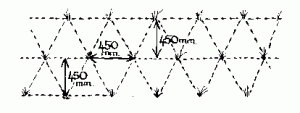
- Plant in staggered rows to limit any problem of wind-scour between the rows and to encourage the even spread of new growth into the intervening spaces. Staggered-row planting also makes it easy to see where you have finished. ‘Random’ planting may look more ‘natural’ at first but it can result in uneven coverage. Staggered plantings soon blend with their surroundings as some plants die and others send up new shoots and spread.

Transplanting methods and work organisation
Arrange details of work organisation according to the site, size of working party and supply of plants. Aim to supply offsets at a steady rate for planting. In some situations, eg where plants must be transported some distance by road or where a mechanical planter is being used, it may be best to have all volunteers dig until the supply vehicle is loaded, then have the same people plant until supplies are exhausted.
Generally, digging the offsets is quicker than planting them. Where the digging and planting site are within easy walking distance, a typical way to organise the task is to have four people digging and loading the plants into containers, two people carrying them between the digging and planting sites and six people planting. It is often easiest if diggers work in pairs to fill containers, so that four diggers use two containers. Planting can be done singly or by teams depending on the site and the inclination of volunteers.
Digging and transporting
- The aim is to extract plants with at least 150mm (6″) of healthy root or rhizome, with two or three nodes from which the new roots or shoots will grow. A longer length of rhizome, of 300mm (1′) or more, is not necessary for successful establishment, and makes planting more awkward. The usual method is to dig, and then pull on the plant so that enough rhizome breaks away from the tangle of roots deep in the sand. The point at which it breaks will depend on the vigour of the plant, the depth you dig and the depth and dryness of the sand. In damp sand, which anchors the rhizomes, you may need to dig deeper to get a sufficient length, as pulling will break the rhizome off short.

- When using a spade or fork, cut out a block of turf and lever it up so you can lift the offsets. Where the root mat is dense you may have to cut the block on all four sides to lift it. Otherwise just cut two sides. You can usually do this without shifting your position.
Leaving the spade or fork in place to minimise disturbance to the soil, reach down and pull apart bundles of offsets. Shake most of the sand loose from the rhizomes so that it falls back into the hole. This lightens the load when transporting and gives a higher proportion of offsets to sand. Lay the offsets to one side or place them directly into the container. After the block is completely separated and removed, pull out the spade or fork and heel in the remaining sand in the hole. - Move a few feet away to dig up another block of grass. Leave plenty of grass in proportion to dug-up ground, to minimise the risk of erosion.
- Gather the offsets and pack them closely into the transporting container. There should be plenty of living stems with succulent white rhizomes and root hairs but don’t bother separating out dead plants unless they form a very high proportion of the total.
For hand carrying by one or two people, polythene bags (eg old fertiliser sacks) are ideal. These keep the plants moist, but should be kept shaded so that the plants don’t overheat. Coil the plants into the bags to minimise tangling. You can also pack plants into old fish boxes or buckets, although these are more cumbersome. For transporting large quantities of grass in a Land Rover or lorry, use old fish nets folded into long thin rectangles. Lay the plants on the folded netting and roll up the nets to form bundles. - If you have to store the offsets for more than a few hours, cover them with damp sand and keep this moist. This is especially important when planting in hot dry weather. See also ‘Work season and storage of plants’, (below).

Pulling
Experienced workers in Cornwall and Merseyside have found that much the best method of gathering transplants is to pull them. This is not only quick and easy, but it disturbs the sand surface less than digging, and most importantly means that the plants are at just the right stage for transplanting. If plants cannot be pulled, they are too old for rapid establishment. Plants should be less than two years old, with plenty of fibrous root. If the shoots are a pinky-purple colour, the plant is too young. The sheath should be dry and yellowing, with the whole plant forming a ‘funnel’ shape.
The only problem is that it does require experience to recognize when plants are at just the right stage. Inexperienced workers can waste time and plant material by pulling plants that do not have sufficient roots on them, or damaging plants that are too old. Digging is a safer method in this case, as it ensures that some viable root is obtained from each plant.
Planting by hand
- It is essential to plant deep enough, so that the active growing point at the leaf base is 50-100mm (2-4″) below the sand surface. This normally means planting about 100mm (4″) deeper than the plant was when lifted. The reason is that the plant is adapted to increasing in vigour by developing new roots and shoots as it grows upwards through the sand. If the growing point is put at the sand surface, the plant stagnates (CCS, 1985).
The number of plants put in each planting hole will depend on the size of the plants. Normally, two large, three to four medium or five to six small plants will be needed, making a bundle of about 38mm (1.5″) diameter, which can be held with the thumb and forefinger touching. Do not bother separating the live stems from dead litter or other species which may be intermixed. Dead material helps trap sand, and probably protects the live stems and provides a mulch when it breaks down. If other species survive along with the grasses, so much the better.
Overall success rates for transplanted marram are usually in the order of 60-70%, so it is wise to include at least two living stems per hole and as many as can be managed, given the available supply and the time and area to be planted.
Heel in each bundle using the foot or palm of the hand. Check them for firmness. They should withstand a gentle tug. - When planting a slope or blowout, start at the top and work downward to reduce the amount of trampling as you work.
If thatching is being done, do this as you plant. You can use thorn-free brushwood to stand on as you work. On very steep slopes, stake straw bales in parallel lines from bottom to top, spaced a few metres apart. By using these as access routes, you disturb the slope much less than if you climb on the unprotected sand face. The stakes can be tricky to hammer in, so work with care and stand on brushwood to keep from sliding. Leave the bales in place after use to help trap sand and to gradually break down and form a mulch. - You can plant offsets using a spade, a dibber or with your bare hands, depending on soil conditions and personal preference. Many people like to use a garden spade, especially when planting in firm ground. In hard or stony ground, a pointed spade such as a Schlich planting spade or a trenching spade is easiest. Working from a standing position, make a notch to take the offset.

Some people favour using a long, narrow spade held ‘back to front’, as the blade makes a concave face for planting against, and leaves the handle nearer the hand, which is quicker and less tiring.
If the hole tends to fill in too quickly, work the spade around to enlarge it and slide the plant down the blade with the blade in the ground. Push the rhizomes well down in the hole as you lift the spade free. This gets the rhizomes deeper than if you pull the spade out first.

In soft sand you can make a hole with a broken, sharpened spade handle, used like a dibber. Garden dibbers are too short to be effective. In firmer sand use a small crowbar.

In very soft sand you can use your bare hands to scoop out a hole. You have to make it extra large so that it stays open long enough to place the offset.

- Always start planting up against any boundary, so the planters are not confined as work reaches completion. Normally it is efficient for each pair to work along a line of about 10-15m length so that teams do not get in one another’s way, whilst remaining close enough to their own supply point (CCS, 1985).
- Two-person planting is best done with a spade. One person should stand to make a notch with the spade while the other kneeling, places the offset.
Where the soil is firm it may be easiest for the person who cuts the notches to work slightly in advance of the planter. He may be able to keep two people busy planting if he works quickly. - Transplants may benefit from fertilising at the time of planting (see below).


Planting by machine
Agricultural planting machinery can be adapted to transplant offsets of marram. This is only worth doing where a large area of relatively flat terrain is to be planted up, but in this situation it is much quicker and less laborious than hand planting.
Nash (1952, p9) says that a root planter pulled by a small crawler tractor improves man-day outputs by five times and reduces costs by 80% compared with a paid labour force. The best system is for a team of five workers to gather offsets all morning and then plant them in the afternoon. When planting, the work party consists of one person driving the tractor, three on the planter and one who keeps the trays on the planter filled with offsets and drives the lorry full of offsets from the digging to the planting site. Where digging and planting are done simultaneously, another five people are needed to keep the lorry supplied.
On the East Lothian coast a tractor-pulled cabbage planter has been used with similar success, but ten people were required to supply it with plants and the marram had to be chopped before being fed through the machine.
Fertilising transplants
Transplants of dune-building grasses may be fertilised at the time of transplanting. The value of this is variable on exposed or unstable dunes but may improve growth considerably on areas less subject to rapid sand movement. When fertilising transplants, it is best to incorporate the first treatment directly into the planting hole, and follow this by periodic top dressings as for sown grasses.
