First aid
Keep a first aid kit available at all times. For six to ten people, the contents are:
A first aid kit suitable for use in a workplace for up to 10 people
| Guidance card | 1 |
| Waterproof plasters | 20 |
| Sterile eye pads, with attachment | 2 |
| Individually wrapped triangular bandages | 4 |
| Safety pins | 6 |
| Medium sterile dressings (12cm x 12cm) | 6 |
| Large sterile dressings (18cm x 18cm) | 2 |
| Alcohol free cleansing wipes | 6 |
| Scissors | 1 |
| Pairs of fine transparent disposable plastic gloves | 2 |
| NOTE: Where mains tap water is not readily available for eye irrigation, sterile water or sterile normal saline (0.9%) in sealed disposable containers should be provided. Each container should hold at least 300ml and should not be reused once the sterile seal is broken. At least 900ml should be provided. Eye baths or other refillable containers should not be used for eye irrigation. | |
| NOTE: The first aid kit must be kept in a suitably marked container which will protect the contents from dust and damp. | |
From experience on tasks, the following are also found to be useful:
Welfare kit suitable for use in additional to a first aid kit
| Pair of tweezers |
| Safety pins |
| Needle and thread |
| Pencil |
| Sanitary towels |
| Whistle |
| Toilet roll |
| Cotton wool |
| 30 plasters |
| 3 finger pouches |
| Rubber gloves |
| Insect repellent |
| 2 x 10p pieces |
| Sun cream |
| Barrier cream |
Earth moving and planting
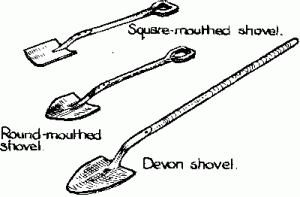
- Round- or taper-mouth shovel for loose soil, sand and shingle, or square-mouth shovel for working off a smooth ‘floor’ or shovelling board. A Devon shovel is ideal for use in stony ground and deep soft sand.
- Heavy-duty treaded digging spade, for general use
- Trenching spade with triangular, slightly bevelled blade, for use in compacted wet sand or for planting marram in hard, stony ground. Small, light ex-WD spades are ideal. A Schlich planting spade can also be used in these conditions.
- Heavy-duty digging fork
- Mattock, grubbing or pick-ended for general use
- Dibber, as an alternative to a spade, for making holes to plant marram and other grasses in soft ground. Purchased dibbers are steel shod and usually have a ‘T’ grip. The top half of a broken spade handle, tapered at the end and sharpened to a point, does just as well in sand and soft ground. A short crowbar may also be used.

- Wheelbarrow. The best type is heavy-duty steel, with a single wheel and long handles for leverage and balance. Pneumatic tyres are essential for work in soft ground. Capacity should be about 0.08 cubic metre (3 cubic feet) since bigger barrows are hard to handle when full. Rubber handles are unnecessary and tend to come off when least expected. A hand barrow, for use by two or four workers is useful for moving small loads short distances over rough terrain.


Clearance
- Bow (bushman) saws, 530mm (21″) and 760mm (30″) sizes for most purposes including rough cutting of fence posts, 910mm (36″) size where a chain saw cannot be used
- Two-man cross-cut saw, for large trees and cutting sleepers
- Axe
- Billhook
- Power tools such as the power chain saw and scrub cutter may be useful but are hazardous, should only be handled by trained operators and should not be used in water.
Construction and fencing
General purpose
- Carpenter’s hand saw
- Hack saw
- Claw hammer
- Lump (club) hammer, 1.5kg (41b) size
- Sledge hammer, 6.3kg (141b) for heavy work
- Crowbar
- Wrecking bar (‘swan neck’)
- Combination or slip-joint pliers
- Screwdrivers, assorted sizes
- Wood chisels, assorted sizes
- Cold chisel
- Brace and assorted bits, for wood
- Hand (ratchet) drill and assorted bits, for various materials
- Spirit level
- Try or combination square
- ‘Surform’ plane
- ‘Stanley’ trimming or retractable knife
- Flexible tape rule
- Plumb bob and line
- Paint brushes, assorted sizes
Additional fencing tools
- Fencing pliers
- Heavy-duty wire cutter (‘bolt cropper’)
- Tinsnips, for cutting netting
- Mell, maul or ‘Drivall’, for knocking in stakes and posts
- ‘Shuv-holer’ (post hole digger) for removal of earth and sand from strainer post holes
- Wire strainer (eg ‘Monkey Strainer’) for tensioning wires to strainer posts
Fires
- Matches
- Solid fuel fire lighter or container of paraffin
- Pitchfork
Miscellaneous
- Hand winch, for scrub and tree clearance, lifting and hauling. TCV use the ‘Tirfor TU16’ winch which has a 760kg (15 cwt) safe working load, with 18m of 11.3mm diameter galvanised maxiflex cable, which has a 1620kg (32cwt) safe working load, fixed with a large eye hook. ‘Tirfor’ winches are made by Tirfor Ltd, Halfway, Sheffield S19 5GZ. An additional length of cable is useful.
- Rope, for dragging brushwood, rubbish etc. Terylene rope is best, 50-75mm (2-3″) in circumference. Nylon rope stretches too much and natural fibres rot quickly unless they can be thoroughly dried after use in wet conditions.
- Sharpening stones. Curved billhooks are best sharpened with a canoe-shaped (flat oval) or cigar-shaped stone. Axes can be sharpened with a canoe-shaped or flat rectangular stone. Flat round axe-stones, although commonly used, are dangerous and difficult to hold.
- Flat files, for taking out nicks and major sharpening of edge tools. Two types are useful, 250mm (10″) bastard for spades and for preliminary filing of axes and billhooks and 250mm (10″) fine mill for final filing of axes and billhooks. Files must be fitted with handles for safety.
- Buckets. Use heavy-duty rubber buckets, not metal or plastic ones which break too easily.
- Binder twine (eg old bale strings)
- Old hessian or polythene sacks (eg fertiliser sacks) for transporting marram plants, stones etc and for keeping small tools collected and out of the sand (plastic sheeting can also be used for the latter purpose).
- Old fish netting, for carrying brushwood, transporting bundles of grass offsets and for various stabilisation uses. Netting can be suspended from stakes about 300mm (1′) high over newly planted areas to cut wind disturbance and help keep people away (perimeter fencing may also be necessary for the latter purpose) or it can be pinned directly on newly planted or seeded surfaces to help retain the soil. Wide-mesh netting should be used to protect transplanted offsets but fairly narrow mesh (eg 25mm, 1″) is better for seeded areas. Nylon netting can be removed for reuse but natural fibre netting may be left in place to rot.
- Knapsack sprayer, horticultural type. For spraying herbicide, a mist nozzle is required (see Brown, 1975 for details), while for spraying non-bituminous sand binders an ‘uncloggable’ nozzle with a wide coverage and reservoir pressures of at least 30psi (8.3g/m2) is preferable. A watering can with the holes of the rose enlarged can be substituted if necessary for distributing binders.
- Water carrier, 22 litre (5 gall.) for use when diluting herbicide or sand binders
- Rags for wrapping edged tools and for cleaning
- Puncture repair kit for waders and wellies: old inner tube, a tin of rubber solution, sand paper and scissors
- Book of tide tables