
Wood as a fuel
Note the following:
- There is an old rule of thumb that an acre of woodland can produce a cord of wood per year indefinitely (a cord = 3.6m3 ; see below). However, taking a cord by cutting scattered trees is difficult and can cause ground damage. A better way is to cut a group or stand of trees each year. These can be left to regrow as coppice, or singled to leave one stem which will grow on to a standard tree.
- Freshly cut or green wood of nearly all species (see below) is useless as a fuel, as it is difficult to light, yields less heat than dry wood, and causes tar deposits in stoves and chimneys.
- Firewood should be dried in the open air until the moisture content is 20-25%. This takes at least six months for most species, and at least a year for elm and beech. Some species produce naturally much drier wood than other species. Freshly felled ash has only about 33% water, and can be burnt without seasoning, whereas fresh poplar is about 65% water. Firewood seasoned for two years is generally best. Wood stored for more than about 3 years may deteriorate due to fungal growth, woodworm or other agents.
- Firewood loses weight as it dries, and as a general rule two tonnes of green wood will produce one tonne of air-dried wood. The table below gives a general guideline for most species.
- A freshly felled cord of wood, which is about 3.6 cubic metres (128 ft3), weighs about 1.5 tonnes.
- Wood is a poor conductor of heat, and burns less efficiently the larger the piece of wood. For stoves, open fires and for conversion to charcoal, the optimum size of log is about 100mm (4”) diameter.
- Wood dries more quickly from cut ends and cleft faces than if left in the round. Larger logs need to be split, both to encourage drying, and to give the optimum size for efficient burning. As splitting involves extra work, cutting the wood when it is no bigger than 10cm (4”) diameter, as produced by coppicing, is the most efficient way of producing firewood.
Table 11a: Weight and moisture content of 1m3 of wood 1 cubic metre Weight % water Use as firewood
| 1 cubic metre | Weight | % water | Use as firewood |
|---|---|---|---|
| Freshly felled | 550kg | 50% | Not suitable (except ash and holly) |
| Seasoned 1 year | 410kg | 33% | Burns adequately |
| Seasoned 2 years | 355kg | 25% | Burns well |
- All types of wood burn more efficiently in wood burning stoves, than on an open fire. On average, air-dried wood burns at 70% efficiency in a free-standing stove, 60% in a built-in stove, and 35% efficiency in open fires. The problem of some woods creating sparks is less significant in stoves.
- Wood needs to be burnt at a fairly high temperature of around 700˚C, which ignites the gases given off by the wood and converts these to carbon dioxide and steam. Filling a stove with wood and then damping it down by reducing the air supply prevent these ‘volatiles’ from burning, and generates smoke and tar. It’s best instead to let the logs burn freely until they almost turn to charcoal, and then damp the stove down. The glowing charcoal will continue to give off heat for some hours.
- Conifer wood is generally less suitable than hardwood for heating. Its resinous nature means it flares up and burns quickly, rather than giving off heat over a longer time. Attempting to burn it slowly means that the resinous sap is not burnt completely, but leaves creosote deposits on the stove and chimney, which can lead to chimney fires.
- Wood ash is a useful garden fertiliser, containing 5-10% K2O (potash), and should be applied in early spring at 125-270g/m2 for improved growth of fruit, flowers and potatoes. It’s particularly useful on acid, sandy soils, but should not be applied to chalky soils. Store the ash in a dry place before use.
Species
Two logs of different species but with the same weight and moisture content will have the same value as fuel.
Table 11b: Properties roperties of wood as fuel
| EASE OF SPLITTING | BURNING SPEED | SPARKS | ||||||
|---|---|---|---|---|---|---|---|---|
| Easy | Medium | Hard | Good | Too slow | Toofast | No | Yes | |
| Ash | • | • | • | |||||
| Beech | • | • | • | |||||
| Hazel | • | • | • | |||||
| Oak | • | • | • | |||||
| Elm | • | • | • | |||||
| Field Maple | • | • | • | |||||
| Hornbeam | • | • | • | |||||
| Hawthorn | • | • | • | |||||
| Birch | • | • | • | |||||
| Holly | • | • | • | |||||
| Rowan | • | • | ||||||
| Sycamore | • | • | • | |||||
| Wild cherry | • | • | • | |||||
| Poplar | • | • | • | |||||
| Alder | • | • | • | |||||
| Willow | • | • | • | |||||
| Sweet chestnut | • | • | • | |||||
| Horse chestnut | • | • | • | |||||
| Lime | • | • | • | |||||
| Conifers | • | • | • | |||||
| Rhododendron | • | • | • | |||||
However, species differ in their density, so that a larger volume of a light wood such as willow or pine would be required to give the same fuel value as a dense, heavy wood such as oak. Freshly felled oak, beech and hornbeam occupy about 1.5m3 per tonne, whereas freshly felled poplar, willow and most conifers occupy about 2.5m3 per tonne.
The most efficient species for planting new firewood coppices are fast growing species such as willow and poplar. Although their calorific value is lower per unit weight than other species, this is outweighed by their speed of growth. Where yield per unit area is not so important, a mix of the better firewood species at the top of Table 11b is likely to give the best value for wildlife, amenity and fuel value.
In addition to coppicing, firewood can also be produced during thinning, felling, hedging, pruning and other operations.
As well as their initial moisture content (see above) species differ in their ease of splitting, their speed of burning, and whether or not they spark. The above table gives some guide to the various properties, with the species listed approximately in order of usefulness.
Firewood coppices
When cutting an existing coppice mainly for firewood purposes, it’s important to remember that all the stools in the coupe must be cut, whatever the suitability of the different species for firewood. If you try and select only the best firewood species and leave others uncut, those that you cut may be too shaded by the remaining trees to regrow vigorously. When cutting a mixed block, you can either use all that you cut for firewood purposes, or you can select out wood of particular value for other purposes, and use the remainder for firewood. For commercial operators the profit from firewood is generally low, and the waste left after higher value species and pieces have been selected may be sold as firewood.
The coupe or cant size and the rotation should be chosen to yield material which is easy to cut and handle, and which is not large enough to require splitting. Poles 6-7m (20-23’) height and 70-100mm (3-4”) diameter are the most efficient size for handling and burning.
Coppices planted mainly for firewood can be designed and planted accordingly with ash, beech, hazel, hornbeam and other species which are best for the purpose, with stools spaced about 3.3m (10’) apart. For information on planting coppices, see here.
A well managed coppice wood containing a full stocking of mixed broadleaved species should be able to produce about 3 tonnes of air dried wood per hectare per year (the old rule of one cord per acre per year is roughly equivalent). Output can be doubled by planting fast-growing species such as willow, poplar or alder. The average figure quoted for heating a three-bedroomed house using wood only is 7-9 tonnes of air dried wood per year, though this figure will vary greatly with location, type of house, insulation and other factors. For most householders, an option of using wood in addition to other fuels is more realistic.
For a three-bedroomed household to be fully self-sufficient in wood fuel would therefore require about three hectares (7.5 acres) of coppice. This could be worked on a ten year rotation, in ten cants, each 0.3 hectare (0.7 acre). Each cant should produce between 7-9 tonnes of air dried wood when cut.
Producing smaller volumes of firewood, or other coppice products, from an area less than about a hectare becomes more difficult. This is because coppice regrowth is affected by the shading of surrounding trees. Larger coupes have a better area to edge ratio than smaller coupes, and are also more efficient to protect against browsing by deer or rabbits. For a coppice of one hectare or less, it’s probably best to divide it into coupes no smaller than 0.25 hectare (0.6 acre), and to cut one coupe every two or three years, depending on the species and rate of growth. In the intervening years firewood may need to be cut from elsewhere, or bought in. Dividing a hectare into ten small coupes for example will reduce the overall yield, as growth in each coupe will be reduced.
Conversion and storage
There is an old saying that firewood warms you three times – when you cut it, when you carry it, and when you burn it. For the wood-stove owner with plenty of time to spare, the cutting, splitting, carrying and stacking of firewood in sunny winter weather is one of life’s pleasures. For larger-scale projects, it’s important to make operations as efficient as possible to reduce conversion and handling. Efficiency is all-important for commercial operations, as profits on firewood are low. Power equipment will be essential for splitting and handling.
There are two basic options: either to cut the wood to length to fit the fire immediately on felling, or to cut to 1.2m (4’) lengths and stack to make a cord. Cutting to length will speed drying, which may be useful if the firewood can only be seasoned for one year before it is needed. Security for storage may be an issue. Where theft or arson is unlikely, cordwood can be stacked in the wood for a year or so, before it is cut up for use.
Splitting wood by hand
The most efficient method of producing firewood is by growing and harvesting coppice at no more than 100mm (4”) diameter. However, splitting larger material from thinning, restoration of neglected coppice and other woodland operations is frequently needed. General information on splitting green wood is given here, with further details given below. Hardwoods are easier to split when freshly cut. Some conifers are easier to split when dry and brittle.
- For any given diameter and type of wood, it is easier to split shorter logs rather than longer. Beginners should start with logs no longer than 200mm (8”), proceeding to 300mm (12”) logs as their skills develop.
- Use a wedge axe or log splitting maul, which has a thick blade with shoulders to split the wood, rather than a narrow headed axe and wedge.
- The speed of striking the log is more important than the weight of the maul. A 6lb maul can be swung much faster than a heavier tool, and is therefore more effective.
- Place the log on a firm surface or on a low cut stump, positioned so that you can stand comfortably slightly uphill of the log, in order to maximise the length, and therefore the speed of the strike.
- Aim to split along any existing line of weakness.
- Start at the edge of the log, not the centre, as the edge is easier to split.
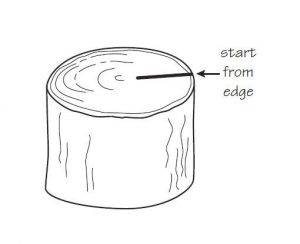
- Use one or more blows to get the first split well started, and then aim at the line beyond the centre of the log.
- Put your effort into making fewer, stronger strikes, resting as necessary. Repeated half-speed attempts will only tire you out and have little effect.
- Standing with feet apart, measure the distance from the log by placing the maul on the log with arms extended, and then take a third of a step back.
- Hold the tool with one hand at the base of the handle, and the other just below the head. As you swing the tool up, let the upper hand slide down to the lower hand. At the top of the swing, the tool should be just behind the vertical line from your body.
- Focusing on the point where you intend to strike, bring the axe down as forcefully as you can, bending the knees and waist.

Storage
Wood does not have to be stored under cover to dry out, and logs stacked or in a pile will dry out over the summer following cutting. Logs can then be transported to be stacked close to the point of use. Minimise handling and restacking. If possible, stack close to the point of use immediately after cutting and splitting. Don’t stack newly-cut wood in a closed shed, as it will rot rather than dry out. Preferably stack in an open-sided shed, barn or lean-to, or in the open, covered with corrugated iron or similar, weighted down. Logs dried for six months or more can be stacked in a dry shed, but ensure there is some ventilation.
If possible, stack small logs and larger logs separately, with kindling in a large box, so that you can easily find what you need. Keep several days’ supplies of kindling and logs in the house, near but not touching the woodstove or range, so it dries to give the best fuel value when burnt.
