This section considers the extraction, stacking and conversion of small size timbers, produced from neglected coppices, early thinnings or clearance operations. The harvesting of large timbers is a specialist job for contractors with the necessary equipment.
Extraction
- Timber should be handled as few times as possible, to save labour.
- Some woodlands have rides suitable for access by four-wheel drive vehicles and trailers, although often only at drier times of year. Many woodlands though, and especially those where voluntary groups are likely to work, have poor access. Inspect the access carefully before agreeing to any extraction work.
- Generally it is easier and safer to drag a pole along the ground, or to lift one end and drag it along using tongs or a similar aid, than it is to pick it up and carry it. Take great care when lifting. Short lengths and small-diameter cordwood can be shifted with a wheelbarrow on suitable terrain.
- Always wear gloves and steel toe-capped boots or wellingtons when handling timber.
- One of the simplest and most versatile tools for hand extraction is a 4.5m (12-16’) length of 10mm (1/2”) rope, spliced into a loop. A loop joined with a knot can also be used, although this is less secure than a splice. This can be used as shown for dragging poles and round timbers up to about 200mm (8”) diameter.

Stacking
General points
- Clear the stacking site of all obstructions, choosing a level site if possible. When stacking across sloping ground, build the stack from the bottom upwards, supported to prevent rolling. Do not support stacks against live trees.

- Stack large logs parallel to each other for stability. Stack smaller logs, which are to be cross-cut, as for cordwood, but don’t bother stacking to standard cord dimensions.
- Shade the ends of newly stacked material from direct summer sun, to prevent them splitting. This precaution is unnecessary once the material is partly seasoned.
- Never walk or climb over stacked wood unless absolutely essential, as you may collapse the stack. Grit from boots also collects on the timber and can damage tools which are later used on it.
- Always leave stacks in a safe, stable condition, especially where there is public access.

Cordwood
Poor-quality material and irregular branches, suitable for pulp, firewood or charcoal burning, should be cross-cut and stacked for storage and sale in cords. A cord is made up of material not more than 1.2m (4’) long. There is no universal standard, but the normal cord has dimensions of 2.4 x 1.2 x 1.2m (8’ x 4’ x 4’) to give a nominal volume of 3.46 m3 (128 ft3). A cord of dimensions 1.8 x 1.2 x 1.6m (6’ x 4’ x 5’4”) gives the same volume.
The solid volume is actually much less than the nominal volume, since even a tightly stacked cord contains about 50% air space. A loosely stacked cord, containing much more air space, has far less sales value.
To make a cord:
- Lay two base poles, 50-75mm (2-3”) diameter and slightly longer than the cord on the ground, about 750mm (2’6”) apart. If the ground is very uneven or the poles irregular, lay them on ‘sleeper’ poles to make a level base.
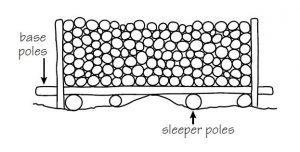
- Provide end-stop stakes to keep the corded wood from rolling off the poles. Drive them well into the ground so that their tops are at least 1.2m (4’) above ground level. Place the stakes outside the poles to prevent the poles rolling apart.

- If more than one cord is to be stacked in a line using the same base poles, drive in stakes every 2.4m (8’) along the poles to help distribute the weight, and to make it easier to count the number of cords in the stack.
- Stack the timber as shown, being careful to centre the timber on the poles and to stack as tightly as possible.


Poles, fencing material and small produce
Stack poles and fencing materials as for cordwood, but stack each layer at right angles to the one below to aid drying. Normally no end-stops are needed, and the stack should be stable on its own.
Stack small produce, such as bean poles, pea sticks, packing rods and tree stakes, in alternating groups of layers, each group about 150mm (6”) thick. Alternatively, bundle the produce ready for transport and sale. See page 112 for further details.
Seasoning
On-site seasoning of roundwood is seldom necessary, apart from that which occurs naturally if the material is left in stacks until conversion. In some cases, where material is sold by weight (eg pulpwood), seasoning should be avoided. Such material should be sold as soon as possible after felling to minimise the loss of value due to drying. Material which is to be converted into products with the bark off, including all material which is going to be treated with preservative, should be peeled at the time of felling.
The time it takes for material to season depends on the type of timber and the weather. As an example, round softwood poles, 150mm (6”) in diameter, stacked in spring, should fully season in about six months.