The process of rebuilding a small gap is essentially the same as rebuilding a wall. However, careful consideration needs to be given to deciding how much of the wall needs to be taken down before a repair can be carried out.
- Remove all the stone from alongside the gap, and set out as outlined on page 41.
- Remove at least 24″ (600mm) of coping either side of the gap to ensure that if any other stones topple it does not instigate a collapse. It can be a good idea to lean a topstone against the remaining coping to hold it in place.
- Examine the wall on either side of the collapse, and dismantle all that is unstable. This usually means leaving the original wall well raked and stepped so it is stable and easy to build into.
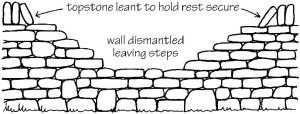
Don’t forget to always leave the safety margin of at least 600mm of coping-free wall either side of the gap. As you get more experienced you will be able to work out, by studying the face of the wall and the overlap of stones, exactly how far along you will have to dismantle. Remove all the coping up to and beyond this point. - Dismantle the remainder of the gap until you have found the cause of the collapse, or until you are sure that the wall is solid enough to build onto. Even if it appears stable, carefully check the wall below. Most collapses higher in a wall are caused by movement lower in the wall. If there are any signs of movement, such as a bulge or loosening of the face stones, then it is advisable to dismantle the wall to a level below these.

Assessing the foundation
Often the cause of a collapse is movement of the foundations. If you expose the foundations during dismantling you need to check they are suitable for building on.
- The stones should be in line. It isn’t a problem if they are slightly outside the line provided they are not tall stones, which would create a step in the repaired face. If they are inside the line they must be replaced or reset, because if you build on them you will not be able to maintain the correct line and batter.
- Foundations in an old wall should be solid, especially considering the weight of stone which has been pressing down on them. Stand on each edge of the stone, and if it moves at all it should be replaced or reset.
- Even if the stone is in line and solid it still needs to be suitable for building on. Often foundation stones have tilted so that they are lower on their outside face, and if you build on them the weight of the wall will be forcing out the lower layers. Sometimes the stone itself is just not suitable, because in old walls you may find the most awkward stones have been used up in the footings. Replace them rather than repeat the mistake.