
This section covers coppicing procedures and techniques.
Coppicing procedure
Depending on the size, age and condition of the coppice stems, you can use a billhook, bowsaw or axe. Loppers and a pruning saw may also be useful. Trained and competent operators can use a chainsaw.
Billhooks are neatest and fastest on hazel or other young regrowth up to about 75mm (3”) diameter, but on older coppice, saws are normally best. The 530mm (21”) bowsaw is useful on multiple-stemmed trees, provided the stems are not too large. A pruning saw is useful for cutting small, closely spaced stems where a bowsaw is too big. Poles larger than 75mm (3”) diameter will require an undercut first to prevent splitting.
Follow basic felling techniques, keeping in mind these additional points:
- Take a close look before you begin cutting. Stones, glass or cans wedged amongst the stems can ruin saws and edged tools.
- Using loppers or a billhook, cut away all small, whippy growth from around the base of the stool, to avoid interference when cutting.
- Remove the stems one by one. Where the stems are all about the same size, cut from the outside of the coppice stool around and inwards, in a spiral pattern.

- Where stems are of varying sizes, it is usually easiest to clear the smaller stems first to give access to the larger ones.
- Cut each stem upward towards the centre, to promote runoff of rainwater and help prevent rot.
- In neglected coppice, where the stems lean outward and are heavy, the saw will jam unless a second worker helps by pushing the stem back off the saw while it is being cut. Even where you can cut from the back of the stem downwards, it helps to have someone support the stem to keep it from splitting.
- Cut stems as low as possible. Normally this should be to the previous level, leaving the existing stool without reducing it. Don’t try to remove the stems all at once by cutting below the top of the stool, as the saw will jam. If you cut too high, the regrowth will be curved at the base and more like branches than stems, and consequently of less value.
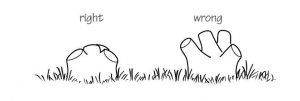
- Where this does not reduce the value of the cut pole, it may be quicker and tidier to cut twice: a high cut to fell the stem and a second cut to remove the stub.
- Hazel should always be cut as close to the ground as possible. This encourages stems to shoot from the ground, rather than from the old stool, which with hazel, can become brittle. Hazel, and to some extent birch and other species, can produce coppice shoots from root buds which are close to the stump.
- In some coppice woodlands, ash and occasionally elm, are traditionally coppiced at 300-900mm (1-3’) high. Unless there are other reasons against this, follow the evidence of past practice.
- If the coppice tree is very large, treat each stem as an individual tree and use the appropriate felling techniques.
- Clean up the stool after coppicing. Cut off any splinters or split wood, and brush dirt and sawdust off the cut surfaces. This reduces the chance of water collecting on the stool and causing rot. If water is lodging in the centre of the stool, cut the stool so it will drain.
- During rest periods, don’t strike or ‘mask’ the billhook or axe into a living stump, as this allows damp to get into the stool.

