The section covers the pruning of young trees during the establishment phase, from about 7 to 15 years after planting. Pruning and surgery of large, mature trees should only be carried out by fully trained and competent persons.
Formative pruning
Pruning is not necessary for native trees, and in many situations trees can be left to develop naturally. Formative pruning involves removing some of the side branches to encourage strong upright growth in the leading stem. When making a decision on pruning, the following points should be considered:
- The value of a timber tree can be considerably increased by formative pruning, to produce a tall, straight trunk without side branches. Branching reduces the straight length of timber, and any side branches which die leave a knot in the timber. Where part of the management objective is timber production, potentially valuable species such as oak, beech, ash and cherry should normally be pruned.
- Pruning of side branches speeds the upward growth of the tree, which can be useful in getting the leading shoot out of the reach of browsing animals or vandals. Young trees are very vulnerable for the first few years, and pruning may be worth doing if it shortens this period.
- In urban and amenity woodlands, the preference for most users is for fairly open woodlands, with views through the trees to encourage feelings of safety. Pruning of lower branches opens up views and access through the trees.
- Pruning as an activity can be useful because it involves close inspection of the trees, and combines well with other aspects of aftercare. The labour intensive nature of pruning work is not a problem for most voluntary groups.
Pruning of broadleaves should commence from when they are 6-8cm (21/2-3”) diameter at breast height (dbh).
Time of year
The best time for pruning oak, ash and cherry is from mid June to mid August, as this reduces the chance of bacterial or fungal infection. In the dormant season wounds are slow to heal and susceptible to damage by frost. Other species can be pruned at the same time, or between September and December. Never prune during the early growing season of February to May, when the sap is rising fast.
There’s no need to prune every tree, but choose the strongest growing, most upright ones of each species, leaving others to branch more freely and create structural diversity. Leading shoots which have forked due to damage or browsing should be pruned to leave a single leader. Trees which have been heavily browsed by deer and have formed a bushy top should be cut back to the main stem to encourage a single leader to emerge. Protect the tree with a sufficiently high tree protector.

Pruning of side branches from the stem can be repeated every other year until the tree is about 10 years old, aiming for a crown of branches about half the height of the tree. Long-handled pruning saws or treetop pruners (p26) will be necessary to reach the side branches. New shoots from the trunk, called epicormics, can be rubbed off or cut away with a sharp knife. Through this type of pruning it’s quite possible for an ash or cherry to grow to at least 6m (20’) height within 10 years. Pruning should stop when the trunk has a diameter at breast height (dbh) of about 12cm (5”).
How to prune
Side branches should be removed before they reach 25mm (1”) in diameter, using a cut as shown below. Don’t cut too close, or you will damage the main stem. Always make the pruning cut to the outside of the branch collar position, although note that the branch collar only becomes obvious on older or mature branches (see below). On the other hand, don’t leave a ‘coat peg’, where rot can start. It’s best to prune at a stage when branches can still be cut through with secateurs or pruners, either long-handled or treetop type for high reach. Pruning saws, both pocket size and long handled can also be used. If the branches are too big to be cut this way, you have left it too late.

High pruning
This involves progressively pruning above 2m (6’) to produce knot-free timber, and is normally only done to selected trees of potentially high value. Pruning up to 4m (13’) can be done using a long-handled pruning saw.
Remedial pruning
In established woodlands it may be necessary to cut larger branches which are overhanging paths or tracks, or to remove branches that are unsafe. Branches over about 150mm (6”) diameter should only be cut by trained and competent persons.
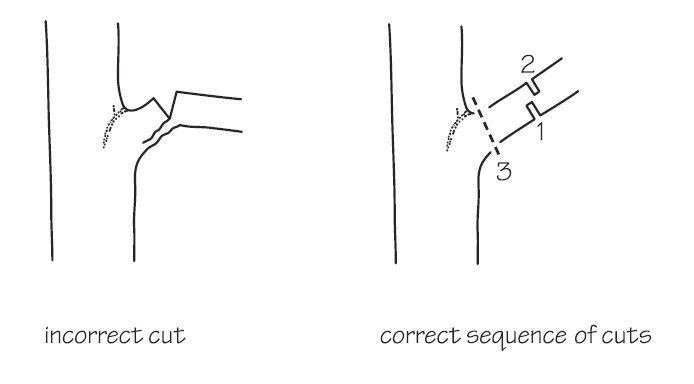
Cut branches over about 25mm (1”) in three stages, as shown. If you try to saw through them with one cut, they are likely to break and pull off a strip of bark, which damages the tree.
Make the first cut about one third of the way through the branch from the bottom, but not so far that the saw binds. Make the second cut as shown, to sever the branch, leaving a projecting stub. Finally, trim the stub with a third cut, starting at the top. Don’t leave a snag or stub. At best, this will only produce unwanted regrowth. More often, stubs die back, providing a foothold for infection and rot which can then be more easily transmitted to the rest of the tree.

Decaying trees are very valuable habitats, and should not necessarily be viewed as a problem, unless they cause a danger to the public. See Chapter 3 – Woodlands, trees and the law for notes on the legal situation regarding unsafe branches.
Wound treatment
There is normally no need to treat cuts and wounds in trees with a wound paint, which in the past was recommended for sealing wounds against fungal attack. If the pruning cuts have been made cleanly and correctly, no further treatment should be necessary. The branch collar forms a barrier to prevent the inward spread of pathogens.