Intervention may be needed in mature, understocked or heavily grazed woodlands to ensure that they survive as woodlands. This will require the encouragement of natural regeneration, or planting. Fencing or individual tree protection is likely to be needed.
Natural regeneration may be needed in ancient replanted woodlands, from which exotic or non-local species have been removed, or in other woodlands which have been cleared of rhododendron or other invasive species.
In the past, ‘high forest’ or plantations in Britain were managed by being clear felled and then replanted. Increasingly, continuous cover systems are being used, under which some woodland cover is retained throughout, and regeneration or replanting takes place amongst it. Continuous cover systems include:
Single tree selection
This is the method of regeneration, used in woods managed for timber production, which most closely matches natural woodland succession. Single trees are selected for felling as they reach the optimum age, and are replaced by natural regeneration or planting. This is only suitable for beech and other shade-tolerant species which are able to grow up in the shade of other trees.
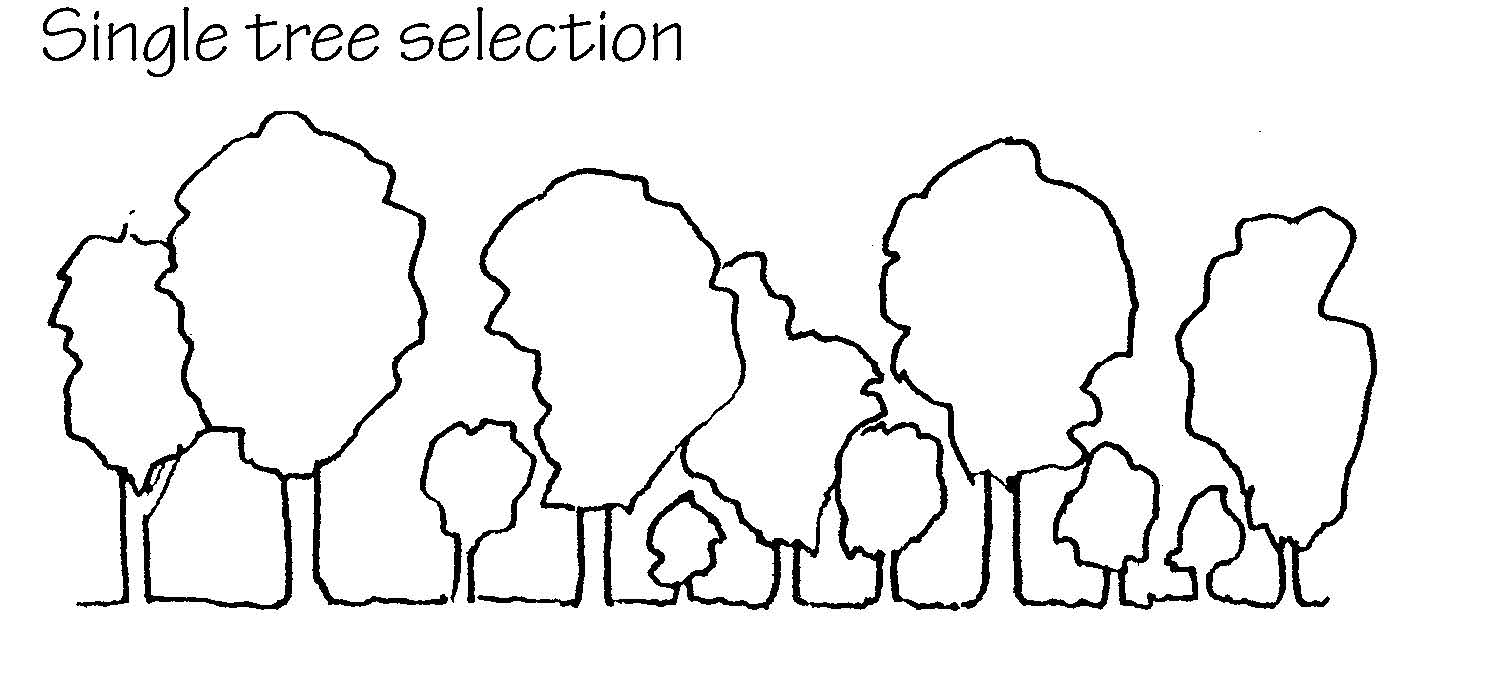
Felling is difficult because of limited space and access, and this system is more expensive than the other systems described below. Its advantage is that it allows the creation of uneven-aged woodlands with a mixture of ages spread through the woodland. It’s most suitable for smaller areas or strips of woodland, where there is light from the side which encourages regeneration and growth.
Group selection
Group selection allows some woodland cover to be retained continuously, whilst giving potential to regenerate light-demanding species. The smallest group felling possible should create a gap with a diameter at least twice the height of adjacent trees. The largest group felled should cover about half a hectare.
Regeneration is normally by planting, but natural regeneration may be possible. Growth should be good, because the site is sheltered but with adequate light.

Shelterwood
A stand of trees is partially felled, leaving a scattered overstorey of mature, seed-bearing trees, spaced with a 6-10 metre (19-33’) gap between the remaining crowns. The overstorey trees supply the seed for regeneration, provide shelter and frost protection to the young trees, and help shade out weed growth. With ash, alder, birch, cherry and sycamore, the overstorey trees are felled three or four years after regeneration. Oak is removed five to seven years after regeneration, and beech can be removed in stages over 15 years after regeneration. Shelterwood systems are common on the continent but not in Britain, apart from in some oak plantations in the New Forest, where planting is used instead of natural regeneration.

Natural regeneration
Natural regeneration as a method of perpetuating woodland is suitable where:
- The desired parent species are present.
- There is already some regeneration taking place, which indicates that regeneration could be successful as a management technique.
- There is no particular need to fell and replant in any one year, and there can be flexibility in the timing of felling to make use of regeneration when it occurs.
- Conservation of local genetic stock is important.
Where regeneration of the desired species is occurring, this can be favoured by weeding and protection. Where regeneration of less desirable species is occurring, this can be used as shelter, and the desired species planted within them.
Regeneration requires:
- Plentiful seed. Apart from rapid colonisers such as birch and sycamore, most British tree species do not produce seed every year, with intervals of 3-5 years being typical. Beech only produces seed every 5-15 years. For further details on seed production see Tree Planting and Aftercare – Propagation. Seed production tends to be more prolific following warm, dry conditions in late summer of the seed year and the previous year. Late spring frosts, high winds or seed predation can cause loss of a seed crop. Successful natural regeneration therefore requires being prepared to use a good seed year when it occurs. An assessment of the developing seed crop can be made with binoculars in late June.
- Sparse ground vegetation. Most species require weed-free ground, although oak regenerates through a grass sward. Bramble, bracken, scrub and rough grasses must be controlled for successful regeneration. This is best cleared by hand or by herbicide application in the August of the seed year. The activity of clearance also roughens or scarifies the ground, which aids regeneration. Beech leaf litter is slow to break down, and if the seeds fall onto deep litter they find it difficult to root through to the mineral layer below. In a beech mast year, you can encourage germination by raking the seed-covered ground, to mix the litter and seed into the soil, and discourage predation by squirrels.
- Protection from animals. Seed may be eaten by mice, squirrels and other animals during the autumn and winter. Some predation is unavoidable, but where this is excessive, for example in some beech woodlands, regeneration will be prevented. Baiting is the only method of control. For protection of seedlings and young trees from browsing animals, see here.
- Low levels of weed competition during the regeneration period. After successful regeneration, the young trees must be kept clear of weed growth, in the same way as planted trees. To give a more even coverage, natural regeneration can be ‘respaced’, by transplanting seedlings into any gaps.
The seed trees
A correctly thinned plantation at rotation age, or a mature managed woodland should have trees appropriately spaced and of suitable growth to allow successful natural regeneration. Normally felling takes place in the winter after a seed year, with timber extracted before April to prevent damage to the regeneration. There are two options for felling.
One option is to fell between 50-75% of the trees, leaving a scattered overstorey, similar to shelterwood, to provide some shade to restrict weed growth, and reduce soil rewetting. When an area is clear felled, the ground tends to become very wet because of the sudden loss of transpiration, which before felling extracted large volumes of water from the soil. Damage by machinery also damages and compacts the ground. This can result in waterlogged ground, the growth of rushes and sedges, and adverse effects on young trees. The retained trees are removed in one or two operations over the next 10 years, taking care to cause as little damage as possible to the young trees. If the expected regeneration is not successful, these trees can be retained until there is another seed year, so giving a second chance. Although more expensive in felling costs, this option is preferable.
Alternatively, all the trees in the area to be regenerated are felled. This is cheaper than phased felling, and avoids potential damage to the regenerating trees. However, there will be strong weed growth which will have to be controlled, and rewetting may be a problem. Also, if the expected regeneration fails, there is no second chance for natural regeneration, and the area will have to be replanted. Replanting a failed regeneration plot, with strong weed growth and patches of waterlogged ground, is likely to be difficult.
Stand opening
Where only a small group of trees are felled, as in group selection (see above), or where shelterwood is used, the amount of light reaching the young trees is limited. Germination does not require light, but growth in the early years does. Different species have different requirements for light, with oak being notable as a light- demanding species. Oak regeneration is more successful at woodland edges or outside the woodland. Ash and beech can tolerate fairly heavy shade for the first few years, but after that full overhead light is required. In shelterwood, the remaining trees must be removed for successful establishment of the new trees. With group selection, further felling or thinning may be necessary to increase light to the new group.
Management of the new stand is needed for at least 10 years, to ensure that shrubby and climbing weed growth is kept under control, and that invasive tree species are removed. Respacing or new planting should be used to fill any gaps larger than 6m between the regenerating trees.